
How Much Does Radiant Barrier Installation Cost in Dallas?
Radiant barrier installation in Dallas typically runs $1,200 to $3,800 for a standard single-family attic, with most homeowners landing between $1,800 and $2,900. That range covers staple-up foil over existing insulation or foil laid directly over attic flooring in homes up to about 2,500 square feet. For a precise number on your house, call (940) 748-1726 and we’ll give you a written quote before any work begins.
Dallas summers are the reason this product exists. Attic temperatures north of 140°F are routine from June through September, and that heat pushes down through your ceiling insulation and into your living space. A radiant barrier reflects that heat back out before it ever reaches your insulation. In neighborhoods like Lake Highlands, Preston Hollow, and Richardson’s Canyon Creek, we see attic temperatures drop 20 to 30 degrees with a proper install, which translates directly into lower cooling bills and a second floor that actually holds its temperature.
Here’s the short version of what you’ll read in this guide: pricing is driven by attic size, installation method, and whether you need old insulation removed first. We break each of those down with real Dallas dollar figures below.
Key Takeaways
- Typical cost: $1,200 – $3,800 for most Dallas homes; $1,800 – $2,900 is the common mid-range.
- Per-square-foot pricing: $0.80 – $2.20 depending on method and foil grade.
- Payback: Many Dallas homeowners see meaningful summer cooling reductions, with the barrier paying for itself in 3 – 5 years in older homes with weak insulation.
- Biggest cost driver: Attic accessibility and whether existing insulation needs removal or air sealing first.
- Fixed written pricing: Alden Insulation Dallas gives you the number before tools come off the truck. Call (940) 748-1726 for a free estimate.
Radiant Barrier Installation Cost Breakdown (2026)
Here’s what we’re actually charging in Dallas this year, broken down by line item so you can see where the money goes.
| Item | Typical Range (Dallas, 2026) | Notes |
|---|---|---|
| Staple-up foil over rafters (per sq ft) | $1.10 – $2.20 | Best performance; requires full attic access |
| Foil laid over attic floor (per sq ft) | $0.80 – $1.40 | Faster install; less effective long-term due to dust |
| Single-sided foil (per sq ft) | $0.80 – $1.50 | Basic option, marginal performance gain |
| Double-sided foil (per sq ft) | $1.20 – $2.20 | We recommend this for Dallas heat loads |
| Typical 1,500 sq ft attic (staple-up, double-sided) | $1,800 – $3,300 | Includes labor, fasteners, and cleanup |
| Typical 2,500 sq ft attic (staple-up, double-sided) | $3,000 – $5,500 | Larger homes in areas like Southlake or Flower Mound |
| Attic air sealing (add-on, not required) | $400 – $1,200 | Seals penetrations before barrier install; often doubles the value |
| Old insulation removal (if needed, per sq ft) | $1.50 – $3.00 | Only necessary if existing insulation is wet, moldy, or pest-damaged |
Those numbers reflect real bids we’ve written in Dallas over the past year, not national averages you’ll find on generic contractor sites. Two things matter more than any other variable: how accessible your attic is and what condition your existing insulation is in.
A wide-open attic with a plywood floor and 8 feet of headroom is a straightforward staple-up job, usually a single day for a crew of two. A low-slope attic with 4 feet of clearance, no decking, and trusses every 16 inches takes longer, runs hotter to work in, and costs more per square foot because the labor is slower and harder. We knew going into the 2025 season that attic labor costs in the Dallas area were climbing, and we’ve priced that in rather than surprising homeowners at the door.
What Affects Radiant Barrier Installation Pricing in Dallas
- Attic square footage: The single biggest line item. A 1,200-sq-ft attic in a Garland ranch home will cost substantially less than a 3,000-sq-ft attic in a Plano two-story. Labor scales close to linearly with area.
- Installation method: Staple-up over the rafters costs more in labor than laying foil over the floor, but it performs dramatically better. Floor-laid foil collects dust within a few years and loses its reflectivity; staple-up foil on the underside of the roof deck stays clean and effective for decades.
- Foil grade: Single-sided foil is a budget product. Double-sided reinforced foil costs 30 – 50% more per square foot but reflects heat from both directions and resists tearing during install. In Dallas’s attic conditions, where installers are working in 130°F heat and tight spaces, the heavier product is the one that doesn’t rip mid-staple.
- Attic access and clearance: Scuttle holes, pull-down ladders, tight roof pitches, and cramped truss spacing all slow the work down. Labor is the biggest portion of any radiant barrier bid, and slow work costs more than fast work.
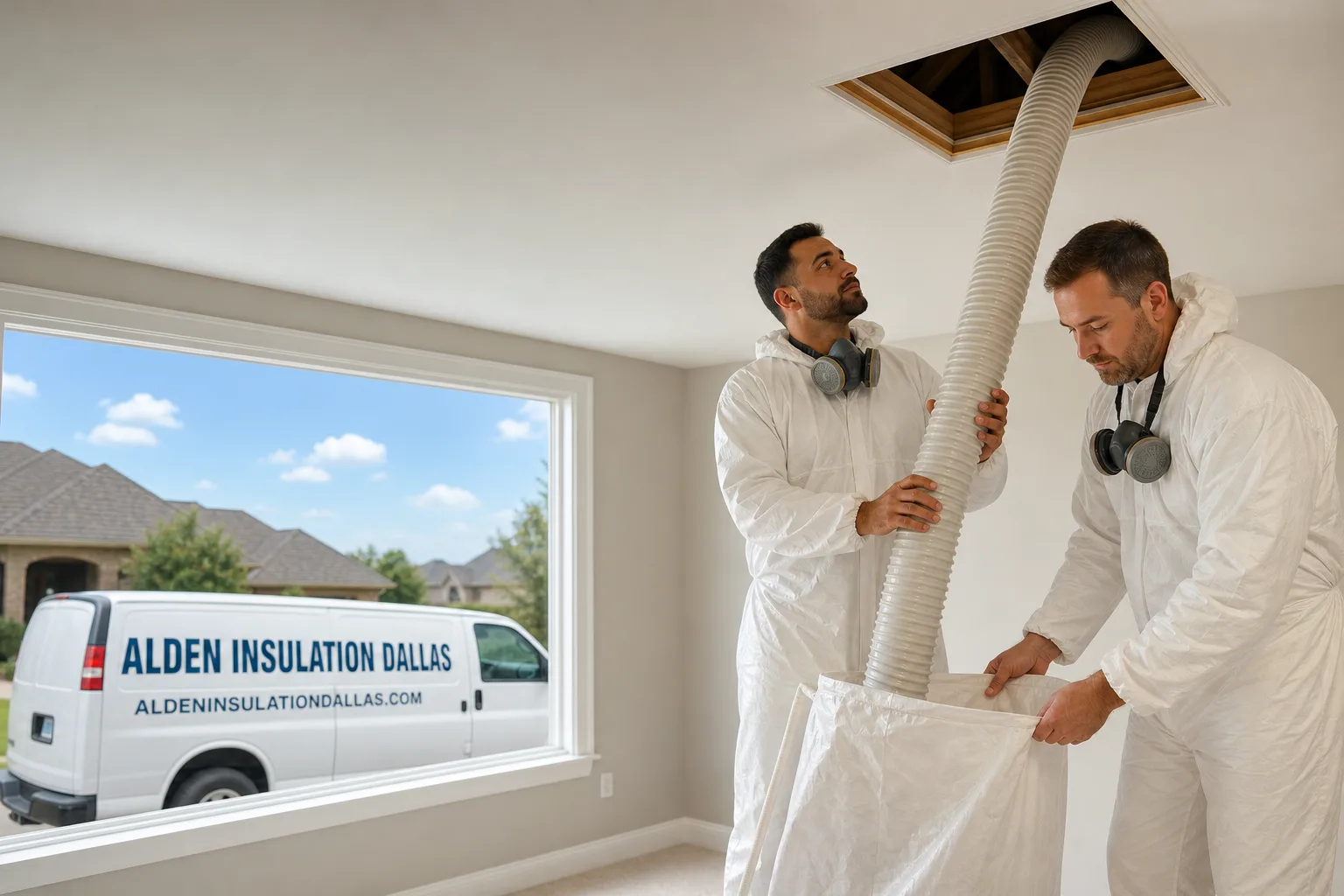
- Condition of existing insulation: If your blown-in insulation is wet, moldy, or full of rodent droppings, it needs to come out before a barrier goes in. We remove insulation using a commercial vacuum system, and that’s a separate line item that runs $1.50 – $3.00 per square foot depending on depth and condition.
- Air sealing scope: A radiant barrier works best when the attic is reasonably sealed at the top plates and penetrations. We offer air sealing as an add-on, and it’s usually $400 – $1,200 depending on attic size and how many can lights, plumbing vents, and wire penetrations need attention. You don’t have to do it, but in Dallas’s humidity profile, it’s the difference between a good result and a great one.
Radiant Barrier vs. More Insulation: Where to Put Your Money in Dallas
Here’s a question we get from homeowners in East Dallas and Mesquite every summer: should I spend on a radiant barrier or just add more blown-in insulation?
The honest answer is that insulation comes first. If your attic has 6 inches of settled fiberglass (roughly R-19) and you’re comparing a $2,000 radiant barrier against a $600 blown-in top-up to R-38 or R-49, add the insulation first. Insulation resists conductive heat transfer all year long. A radiant barrier only fights radiant heat gain, which is primarily a summer phenomenon.
But if your attic already has adequate insulation and your second floor still runs 8 to 10 degrees hotter than the first floor from May through October, a radiant barrier is the right next step. In homes built before 1990 in Dallas proper, the combination of R-38 insulation and a staple-up radiant barrier typically drops attic temperatures from the 140°F range down to 105 – 115°F. That reduction in temperature differential across your ceiling means your AC doesn’t have to work as hard to hold 74°F indoors.
The two products do different jobs. Insulation slows heat transfer. A radiant barrier reflects heat away before it starts transferring. In a Dallas summer, you need both. If you want to know which one matters more for your specific attic, call us at (940) 748-1726 and we’ll tell you straight.
How Much Does Radiant Barrier Save on Cooling Bills in Dallas?
The DOE and Oak Ridge National Laboratory have published studies on radiant barriers, and the consensus number is a 5% to 10% reduction in summer cooling costs for homes in hot southern climates. In Dallas, where the average August electric bill for a 2,000-sq-ft home runs $220 – $320 depending on thermostat habits, that’s a savings of roughly $15 to $30 per month during peak cooling season.
Over a typical Dallas cooling season (roughly 7 months of meaningful AC use), expect $100 to $210 per year in direct energy savings from a properly installed radiant barrier. At a $2,500 installed price, that’s a simple payback of 12 to 25 years. That’s the straightforward math, and we want to be honest about it: a radiant barrier is not the fastest payback in home energy improvement.
What the payback math misses is comfort. A second floor that holds the same temperature as the first floor has real value. A home office over a garage that doesn’t become unusable at 3 p.m. in July has real value. An AC system that cycles normally instead of running continuously from noon to 8 p.m. lasts longer. We see customers make the call for comfort reasons far more often than for payback-period reasons.
Radiant Barrier Installation Methods and What They Cost
Staple-Up (Under the Roof Deck): $1.10 – $2.20 per sq ft
This is the method we recommend in Dallas. The crew staples foil to the underside of the roof rafters, leaving a 1-inch air gap between the foil and the roof deck sheathing. That air gap is essential; without it, the foil would conduct heat rather than reflect it. This method keeps the foil clean, keeps it out of the way, and maximizes its reflective performance for 20+ years.
The work itself is physically demanding. Our technicians are in a 130°F attic, working overhead with staple guns for hours at a time. Dallas attics in July are dangerous places to work, which is why we schedule installs for early morning starts, and why our crews are experienced in heat management. This isn’t a job for a weekend DIY attempt. The combination of heat, tight spaces, and a staple gun overhead leads to torn foil, missed staples, and a product that sags within a year if the installer doesn’t know what they’re doing.
Floor-Laid (Over Existing Insulation): $0.80 – $1.40 per sq ft
The cheaper method is to lay foil directly over the top of existing blown-in insulation. It’s faster, requires less labor, and costs noticeably less per square foot. The downside is real: dust settles on the foil’s surface within 2 to 3 years, and once dust covers the reflective surface, the foil’s radiant barrier performance drops sharply. It also compresses the insulation beneath it slightly, which reduces the insulation’s R-value.
We’ll install floor-laid foil if a homeowner asks for it, but we explain the tradeoff clearly first. In most Dallas attics, staple-up is the better long-term investment. The floor-laid method makes more sense in attics that are already tight and difficult to access, or in situations where the budget is the controlling factor and the homeowner understands the dust issue.
Does Radiant Barrier Work in Dallas-Fort Worth’s Climate?
Dallas sits in a climate zone where radiant barriers produce among the highest measurable benefits in the country. The combination of intense summer solar gain, long cooling seasons, and attics that regularly exceed 130°F makes this metro area one of the most cost-effective places in the U.S. for radiant barrier installation.
We see the strongest results in homes built before 2000 that still have original insulation levels. A 1980s brick ranch in Richardson with R-19 in the attic will show a bigger temperature drop from a radiant barrier than a 2020 build in Prosper that already has R-49 and a cool roof. The older the home, the more headroom there is for improvement, and the more dramatic the result feels.
One thing specific to DFW: hail. Radiant barriers don’t protect against hail damage to the roof deck, and they don’t need to be replaced after a hail storm. But if you’re getting a roof replacement, that’s the single best time to install a staple-up radiant barrier. The roof deck is exposed, the old underlayment is off, and the install can be done more cheaply as part of the roofing job. If you’re already paying for a new roof on your Dallas home, ask your roofer about radiant barrier underlayment, or call us before the roofers arrive and we’ll coordinate.
How to Save on Radiant Barrier Installation
- Get multiple written bids: Don’t accept a verbal number from anyone, including us. Written pricing forces the contractor to stand behind the number. That’s why every Alden quote is written down before work starts and signed by the homeowner.
- Bundle with other attic work: If you need air sealing, insulation top-up, or insulation removal, combining them into one visit saves on mobilization costs. We write a single scope with one price, not a series of surprise add-ons.
- Schedule in shoulder season: Spring and fall installs are easier to schedule, and our crews aren’t fighting 130°F attics, which sometimes allows lower labor pricing than peak summer when demand spikes.
- Check for utility rebates: Some Dallas-area co-ops and municipal utilities offer rebates for radiant barrier installation. Oncor’s program has varied over the years. It’s worth a call to your provider before you schedule.
- Don’t buy the cheapest foil: The single-sided, thin product is cheaper per square foot but tears during install and loses reflectivity faster. The labor cost is the same either way. Spending an extra $0.30 – $0.50 per square foot on a better product is the cheapest upgrade in the whole bid.
- Call for a free estimate: We don’t charge for estimates. Call (940) 748-1726 and we’ll come out, measure your attic, and hand you a written price. No obligation, no follow-up pressure.
Why We Quote Radiant Barrier Jobs the Way We Do
Alden Insulation Dallas is home to a different kind of attic crew. We’re independently owned and operated, held to The Garrison Standard, and we’ve been doing this work since 2002 as part of the Garrison Partners family. The Garrison Code is simple: show up when you say you will, write the price down before you start, and stand behind the work for a full year. Every job.
Our technicians are background-checked and arrive in uniform. You’ll know who’s walking into your home. The office phone is answered by a live person 24 hours a day, seven days a week, not a voicemail tree. If you call on a Sunday night because your attic feels like an oven and you want to talk through options, a human being picks up.
On radiant barrier work specifically, we install products from industry-respected brands including Owens Corning, Johns Manville, Knauf, Rockwool, CertainTeed, Icynene, Demilec, and GreenFiber. For radiant barriers, the foil product matters less than the install quality, but we use the same standard of materials across the board. You can research any of those brands before you commit. We want you to.
Bryce Holloway leads our Dallas operation, and the consistent feedback we hear from homeowners is that the quote they approved is the invoice they paid. No revisions at the door. No “we discovered something” phone call. That’s the point of The Garrison Standard, and it applies to every job at every location.
FAQs – Radiant Barrier Installation Cost
How much does radiant barrier cost per square foot in Dallas?
Radiant barrier installation in Dallas costs $0.80 to $2.20 per square foot depending on the installation method and foil grade. Staple-up over the roof deck runs $1.10 – $2.20 per square foot, while floor-laid over existing insulation costs $0.80 – $1.40 per square foot. Call (940) 748-1726 for an exact quote on your attic, free of charge.
Is radiant barrier worth the money in Texas?
In Dallas, a radiant barrier typically reduces summer attic temperatures by 20 to 30 degrees, which produces a 5 – 10% reduction in cooling costs. For most homes, that’s $100 – $210 per year in savings, but the bigger benefit is comfort: a second floor that stays cool and an AC that doesn’t run nonstop from noon to sunset. For many Dallas homeowners, that’s the deciding factor.
Can you install radiant barrier in an existing attic?
Yes. Staple-up installation in an existing attic is our most common radiant barrier job in Dallas. The crew staples foil to the underside of the roof rafters, which keeps it clean and effective for the life of the product. The work takes one to two days depending on attic size. Radiant Barrier Installation in Dallas by our crew includes full cleanup, and the price is written before we start.
How long does radiant barrier installation take?
A typical Dallas home takes 4 to 8 hours for a staple-up install, with most jobs completed in a single day. Larger attics over 2,500 square feet, or homes with difficult access, may require a second day. We schedule morning starts during summer months so the crew works in the coolest part of the day.
Does radiant barrier need to be replaced?
A properly installed staple-up radiant barrier lasts 20 years or more with no maintenance. Floor-laid foil over insulation will need attention within 3 – 5 years because dust settles on the reflective surface and reduces performance. This is one reason we push staple-up installs as the long-term value play for Dallas homeowners.
Is it cheaper to install radiant barrier yourself?
You can buy foil at a home center for $0.30 – $0.70 per square foot, which makes the material cost look attractive. But attic installs in Dallas are hot, cramped, and physically demanding work. Torn foil, missed staples, and a product that sags within a year are common outcomes. By the time you factor in tool rental, your time, and the very real risk of heat injury in a 130°F attic, professional installation is the better financial and physical decision.
Pricing reflects the Dallas market as of 2026. Alden Insulation Dallas offers free estimates – call (940) 748-1726.
Written by Bryce Holloway, Owner at Alden Insulation Dallas, serving Dallas, TX since 2002.
What Our Customers Say
"Good job. Crew was an hour late the first morning, but finished everything in a day."
- Tim K."Attic was uneven before and now every room is the same temperature."
- Gil N."Tidy crew. Vacuumed the hall and covered the hatch."
- Bea J.