
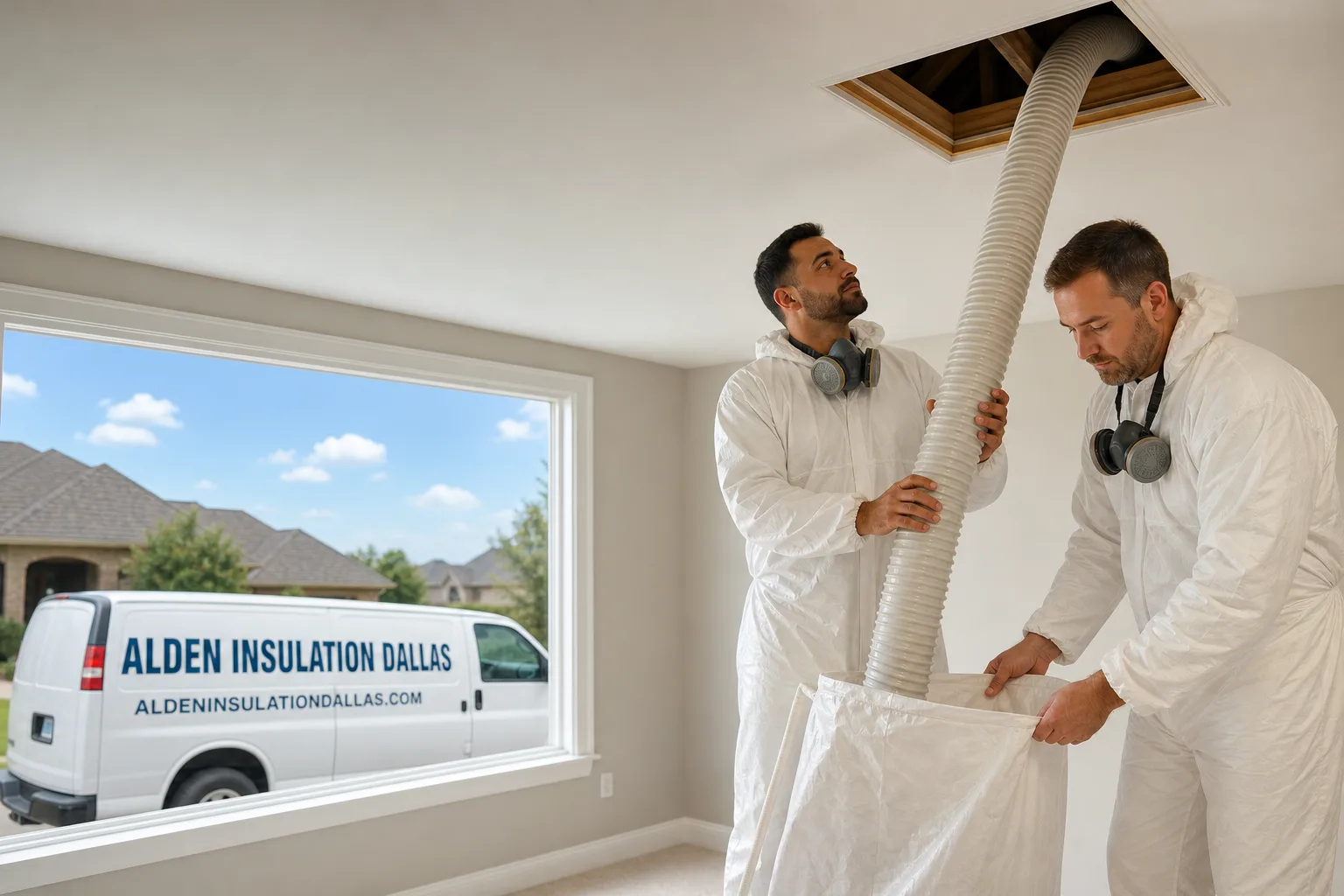
How Much Does Spray Foam Insulation Cost in Dallas?
Spray foam insulation in Dallas typically costs $2.50 to $6.50 per board foot installed, with most whole-attic projects landing between $4,500 and $14,000 depending on square footage, foam type, and current R-value. Open-cell foam runs $0.45 to $0.85 per board foot for material, while closed-cell runs $1.00 to $2.10 per board foot before labor. For a typical 1,500-square-foot attic in Dallas, homeowners should budget $6,000 to $9,500 for a full spray foam application.
Those numbers reflect what we see across Dallas neighborhoods every week, from Lakewood to North Dallas to Oak Cliff. If you want a written price for your specific attic, call (940) 748-1726 and we’ll schedule a free estimate. No ranges that change at the door. The number we put in your hand is the number on the invoice.
Spray Foam Insulation Cost Breakdown (2026)
The table below gives you real Dallas pricing for the two foam types and the most common application areas. These are installed prices, not material-only numbers.
| Project Type | Typical Dallas Cost Range | What’s Included |
|---|---|---|
| Open-cell spray foam (attic roof deck) | $2.50 – $4.00 per board foot | Foam, labor, prep, cleanup |
| Closed-cell spray foam (attic roof deck) | $4.00 – $6.50 per board foot | Foam, labor, prep, cleanup |
| Rim joist / band joist sealing (crawl space) | $900 – $2,200 total | Closed-cell foam, access prep |
| Existing attic insulation removal + spray foam | $1.50 – $3.00 per sq ft for removal, then foam cost | Removal, disposal, foam install |
| Whole-attic spray foam (1,000 – 1,500 sq ft) | $4,500 – $9,500 | Full coverage to R-38 or R-49 (closed-cell) |
| Whole-attic spray foam (2,000+ sq ft) | $8,000 – $14,000+ | Full coverage, larger volume discounts |
Board foot pricing confuses a lot of homeowners, so here’s the plain version: a board foot is a one-foot-by-one-foot area sprayed one inch thick. A 1,500-square-foot attic sprayed to 5.5 inches of open-cell foam is roughly 8,250 board feet. Multiply that by $2.50 to $4.00 and you’re looking at $20,625 to $33,000 for open-cell at full depth, but that’s the upper bound. Most Dallas homes don’t need maximum depth everywhere. Roof lines, peak heights, and existing insulation all change the math.
Open-Cell vs. Closed-Cell: What You’re Paying For
Open-cell foam is less expensive per board foot and does a strong job in attics where air sealing matters more than moisture control. It’s spongy, roughly half the price of closed-cell, and its R-value lands around R-3.5 per inch. In Dallas, open-cell works well in vented attics and interior wall cavities.
Closed-cell costs more because it does more. It’s rigid, adds structural strength, acts as a vapor barrier, and delivers about R-6.5 to R-7 per inch. For Dallas crawl spaces, rim joists, and unvented attic assemblies, closed-cell is the right call. The higher price reflects denser material and the fact that you need fewer inches to hit the same R-value.
What Affects Spray Foam Insulation Pricing in Dallas
Every attic is different, and the number moves for specific, explainable reasons. Here’s what actually changes the price when we walk a Dallas home:
- Existing insulation condition. If the attic has old fiberglass batts or settled blown-in material, we have to remove it before spraying. Removal in Dallas runs $1.50 to $3.00 per square foot, and it’s non-negotiable for a proper bond between foam and roof deck. Homes in Richardson and Plano with 1990s-era insulation almost always need this step.
- Roof pitch and attic accessibility. Steep rooflines and tight attics slow the crew down. A walkable attic with 8-foot clearance is faster than a 4/12 pitch crawlspace. Labor is the biggest variable in spray foam pricing, and access drives labor hours.
- Target R-value and building code. Dallas sits in IECC Climate Zone 3, which calls for R-38 attic insulation. Closed-cell foam hits that at about 5.5 to 6 inches. Open-cell needs closer to 10 to 11 inches. More inches means more board feet means more cost.
- Square footage of the roof deck, not the floor. A 1,500-square-foot attic floor often has 1,800 to 2,200 square feet of roof deck once you account for slope. The roof deck is what gets sprayed, so the price follows the deck area. This surprises homeowners who measured floor space only.
- Crawl space and rim joist scope. If the home has a pier-and-beam foundation with open rim joists, sealing those with closed-cell foam adds $900 to $2,200 depending on linear footage. Many Dallas homes from the 1940s through 1960s in East Dallas and Oak Cliff fall into this category.
- Foam type selection. This is the single biggest pricing lever. Open-cell at $2.50 to $4.00 per board foot versus closed-cell at $4.00 to $6.50 per board foot on a 6,000-board-foot job is a $9,000 to $15,000 swing. The choice should come down to moisture control needs and whether the attic is vented or unvented.
Spray Foam Cost vs. Other Insulation Types in Dallas
When homeowners compare spray foam to the alternatives, the spread looks like this:
- Fiberglass batt (blown-in or roll): $1,800 to $4,000 for a typical Dallas attic. Lowest upfront cost, but air sealing is minimal and R-value degrades as the material settles.
- Blown-in cellulose: $2,200 to $5,000. Better coverage than batts, made from recycled material, but still leaves gaps around penetrations.
- Open-cell spray foam: $4,500 to $9,500 for a whole attic. Seals air leaks completely, which is the real reason Dallas homeowners choose it.
- Closed-cell spray foam: $8,000 to $14,000. The highest upfront cost, but the only option that adds structural rigidity and blocks moisture migration.
Spray foam isn’t the cheapest. We say that plainly. What it does that fiberglass and cellulose can’t do is stop the air movement that carries heat into and out of your home. In a Dallas summer, an attic can hit 140°F. The difference between an attic that’s merely insulated and one that’s sealed is not subtle on the electric bill.
How to Save on Spray Foam Insulation
There are legitimate ways to bring the number down without cutting corners on the install:
- Get a written line-item quote and compare scope, not just price. Two companies can quote the same attic with $4,000 difference because one quoted open-cell and the other closed-cell, or one included removal and the other didn’t. Written pricing eliminates that game.
- Consider open-cell if your attic is vented. A properly vented Dallas attic with soffit and ridge vents doesn’t need closed-cell’s vapor barrier. Open-cell at the correct depth seals air and saves $4,000 to $9,000 on a full attic.
- Check for utility rebates. Oncor and CoServ, the two main electricity providers serving Dallas, have historically offered insulation rebates through their energy efficiency programs. These programs shift year to year, so call your provider and ask what’s active.
- Handle removal separately if you’re able. Removal is skilled labor with specific equipment requirements and dust containment needs. We don’t recommend homeowners tackle insulation removal themselves, and here’s why: old insulation can hide rodent droppings, electrical hazards, and decades of dust. A mask from the hardware store isn’t adequate protection. Let the crew handle it and budget for it upfront.
- Bundle attic air sealing with the foam. If the attic has recessed lights, chase penetrations, or unsealed top plates, sealing those gaps as part of the spray foam job is more cost-effective than a separate air sealing visit later.
We give free estimates. Call (940) 748-1726, we’ll walk the attic, and the number we give you is the number you’ll pay. No pressure. No re-quote at the door.
Why Spray Foam Costs What It Costs
The material isn’t the only thing on the invoice. Understanding the dollars helps homeowners see why spray foam carries a premium over fiberglass:
- The foam itself is a two-part chemical product. Isocyanate and polyol resin mix at the spray gun tip and expand within seconds. The chemistry, the storage requirements, and the mixing equipment all cost more than a bag of fiberglass.
- Application requires trained, certified technicians. Spray foam is not a forgiving material. An inexperienced applicator produces off-ratio foam that smells, off-gasses, or fails to cure. The labor rate reflects that a qualified crew is running the rig.
- Job site preparation is extensive. We mask off the attic, cover any stored items, run ventilation, and suit up in full PPE. That prep time is real labor time, and it’s part of the price.
- Equipment maintenance is continuous. Spray foam rigs run heated hoses, proportioners, and high-pressure guns. The equipment cost is amortized across every job, but it’s always there.
Our crew installs products from Owens Corning, Johns Manville, Knauf, Rockwool, CertainTeed, Icynene, Demilec, and GreenFiber. We name these brands because you should be able to look up exactly what goes into your attic before you say yes. If a contractor won’t tell you what they’re spraying, walk away.
Is Spray Foam Insulation Safe Once Installed?
This is the question every homeowner should ask, and the answer is: yes, when mixed correctly and allowed to cure fully. Off-ratio foam, applied by unqualified crews, is the source of almost every spray foam horror story. The two chemical components have to mix at the correct temperature and pressure, or the foam doesn’t cure properly and the smell persists.
During installation, the attic is not a place you want to be. The crew wears respirators. We ask homeowners to stay out of the house during application and for a re-entry window after. Once the foam has cured, typically within 24 hours, it’s inert and stable.
What does this mean for pricing? A contractor who’s significantly cheaper than everyone else is often cheaper because they’re cutting corners on equipment, training, or material quality. The foam we install from Icynene and Demilec goes through third-party testing. Cheaper is not the same as less expensive when you’re counting the cost of a re-spray or a lingering odor.
Dallas-Specific Factors That Change the Price
Dallas has quirks that affect spray foam pricing more than people realize:
- Clay soil and foundation movement. Dallas sits on expansive clay. Homes move. Closed-cell foam adds structural strength to walls and roof decks, which matters in older homes. This is one reason closed-cell remains popular in Dallas even though it costs more.
- The heat is the whole game. Dallas averages 97°F highs through July and August. Attics in older homes without radiant barriers or proper ventilation can hit 140°F. Spray foam reduces the heat loading on the ductwork, and in Dallas, most HVAC ductwork runs through the attic. That’s a real energy savings driver here that doesn’t apply in cooler climates.
- Older home stock in specific neighborhoods. East Dallas, Oak Cliff, and pockets of Richardson and Garland have homes built before 1970 with minimal insulation. These attics often have old knob-and-tube wiring or vermiculite. If vermiculite is present, it has to be tested for asbestos before we touch anything. Testing adds $50 to $150 and a week of lead time.
- HOA restrictions in North Dallas suburbs. Some HOAs in Frisco, McKinney, and Plano have rules about roof deck treatments and insulation types. We’re familiar with the common restrictions, but check your HOA documents before committing.
What the Crew Does on a Dallas Spray Foam Job
Here’s the sequence, so you know what the price covers:
- Walkthrough and measurement. We measure the roof deck, check existing insulation depth, inspect the venting setup, and identify any electrical or access problems.
- Prep. We seal off the attic access, mask anything that shouldn’t be sprayed, and set up ventilation to the exterior.
- Existing insulation removal if needed. For attics with old material, we remove it first, bag it, and dispose of it.
- Spray application. The crew applies foam to the target depth, working in passes. Depth is checked with a probe as we go.
- Trim and inspection. Excess foam is trimmed, depth is verified, and the crew walks the entire surface.
- Cleanup. All masking is removed, the area is vacuumed, and we confirm with you before we leave.
This process takes one to two days for most Dallas attics. Single-day jobs are possible for smaller attics without removal. The labor sequence above is included in the per-board-foot numbers we quoted earlier.
How Much Does Spray Foam Insulation Cost for Common Dallas Home Sizes?
Here’s what we see on the ground, by home size:
- 1,200 sq ft home (typical Lakewood or Casa View bungalow): Roof deck is roughly 1,500 to 1,700 sq ft. Open-cell: $3,800 – $6,800. Closed-cell: $6,000 – $11,000.
- 1,800 sq ft home (common in Richardson and Mesquite): Roof deck around 2,200 to 2,500 sq ft. Open-cell: $5,500 – $10,000. Closed-cell: $8,800 – $16,000.
- 2,500 sq ft home (North Dallas or Carrollton two-story): Roof deck around 3,000 to 3,400 sq ft. Open-cell: $7,500 – $13,600. Closed-cell: $12,000 – $22,000.
- 3,500+ sq ft home (Preston Hollow or Plano): Roof deck 4,000+ sq ft. Open-cell: $10,000 – $16,000. Closed-cell: $16,000 – $28,000.
These ranges assume standard 8-foot ceilings and a roof pitch between 4/12 and 8/12. Steeper roofs push the deck square footage up. Flat roofs in some Mid-Century Dallas homes are a different application entirely and require different pricing.
Spray Foam Insulation and Dallas Building Codes
Dallas enforces the International Residential Code with local amendments. The current code requires R-38 for attics and R-19 for floors. Closed-cell spray foam meets R-38 at roughly 6 inches of depth. Open-cell needs about 10.5 inches.
There’s a specific code note for spray foam in Dallas: if you’re converting a vented attic to an unvented, conditioned attic assembly, the foam must meet the air impermeable insulation requirements in IRC Section R806.5. That section requires closed-cell foam or a combination of foam and fibrous insulation in specific ratios. This is not a DIY reading project. A licensed contractor who does Dallas attics every week knows what passes inspection.
If you’re in an older Dallas home with an unpermitted attic conversion, be straightforward with your contractor about it. The foam application changes the thermal boundary of the house, and code wants that boundary done properly.
FAQs – Spray Foam Insulation Cost
How much does spray foam insulation cost per square foot in Dallas?
Installed spray foam in Dallas runs $2.50 to $6.50 per board foot. That translates roughly to $0.85 to $2.20 per square foot of roof deck per inch of depth, but board feet is the standard unit because foam depth varies. A 1,500-square-foot attic sprayed to typical depth will cost between $4,500 and $9,500. Call (940) 748-1726 for a written quote on your roof deck, and we’ll give you an exact number, not a range.
Is spray foam insulation worth the cost in Texas?
For most Dallas homeowners, yes. Spray foam typically reduces attic temperatures by 30°F to 50°F in summer and cuts the air leakage that drives cooling costs. The payback period runs 5 to 10 years depending on your HVAC usage, but the comfort difference is immediate. Homes with ductwork in the attic, which is most of Dallas, benefit most because the ducts stop sitting in 140°F heat.
Can you spray foam an existing attic without removing old insulation?
No. Spray foam adheres to the roof deck, not to existing insulation. Old batts, blown-in material, or anything between the deck and the foam has to come out first. Removal costs $1.50 to $3.00 per square foot in Dallas. We include removal in every quote where it’s needed, so there’s no surprise line item later.
How long does spray foam insulation last?
Properly installed spray foam lasts the life of the home. It doesn’t settle, sag, or lose R-value over time like fiberglass and cellulose do. The foam itself is inert once cured. We back every job with our 365-Day Done Right Promise: if the work fails within a year, we come back and make it right at no charge. Our guarantee is in writing before we start, and it’s valid for a full 365 days.
What’s the difference in cost between open-cell and closed-cell foam in Dallas?
Closed-cell runs about 60% to 100% more than open-cell per board foot. On a full attic, that’s typically a $4,000 to $9,000 difference. Open-cell is the right choice for vented attics where air sealing is the goal. Closed-cell is right for unvented attics, crawl spaces, and anywhere moisture control or structural reinforcement matters. If you’re not sure which fits your home, call (940) 748-1726 and we’ll explain it during the free estimate.
Get a Written Spray Foam Price in Dallas
We’re Alden Insulation Dallas, part of the Garrison Partners family, which has been operating since 2002. Every location is independently owned and operated, held to The Garrison Standard, and run by Bryce Holloway. That standard means written prices, written guarantees, background-checked uniformed technicians, and a crew that shows up inside the window it promised.
Our home page has more about how we operate, and our Spray Foam Insulation in Dallas page covers the full service detail. If you’re ready for a real number, call (940) 748-1726. A live person answers, 24/7. We’ll schedule the walkthrough, measure the attic, and put a written price in your hand before any work begins. That’s the only way we do business.
Pricing reflects the Dallas market as of 2026. Alden Insulation Dallas offers free estimates – call (940) 748-1726.
Written by Bryce Holloway, Owner at Alden Insulation Dallas, serving Dallas, TX since 2002.
What Our Customers Say
"Removed rodent-damaged insulation, sanitized, and replaced it. Thorough and honest."
- Sue M."Clear estimate with R-value listed. No hidden extras."
- Hank T."Good job. Crew was an hour late the first morning, but finished everything in a day."
- Tim K.